Capt Jacob Poe
Capt Jacob Poe was a riverman, first and last, and his river exploits personify an Ohio River steamboat man. The grandson of the famous frontier Indian fighter Adam Poe, Jacob Poe carried well the mystique that goes with the name. Capt Jacob Poe’s career as a steamboat pilot and owner of numerous packets spanned more than fifty years and enjoyed the rise of steamboat commerce and suffered its decline. During the golden age of steamboats, he steamed on all the inland rivers and tributaries of the Mississippi, Ohio, and Missouri river systems. He traveled far, saw much, and accumulated considerable wealth. In 1855, a packet built in Freedom, PA was named in honor of Jacob Poe. To be sure that tribute was fitting and proper.
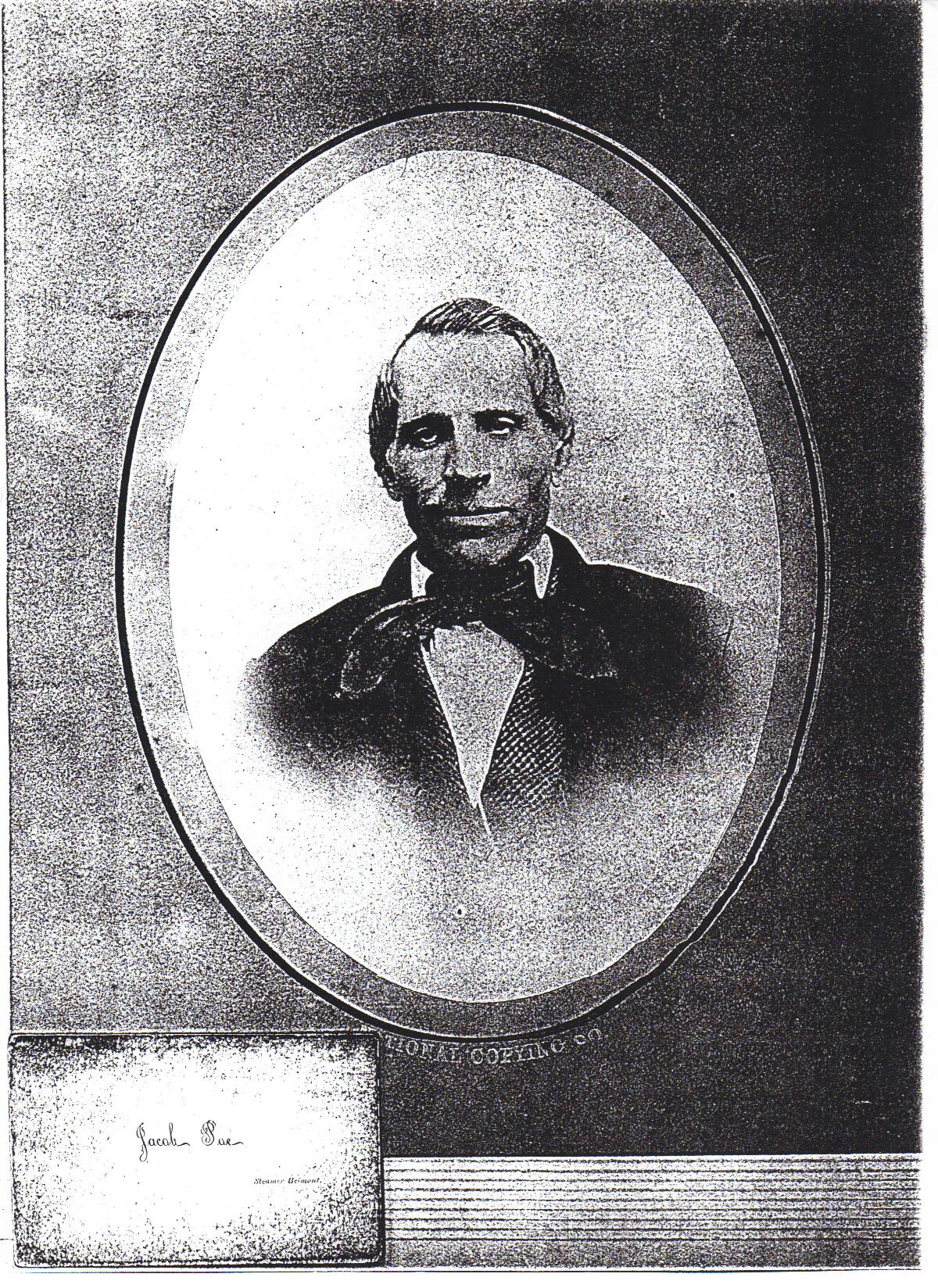
Jacob Poe with Str Belmont Card (Anna L and John F Nash Collection)
Perhaps most important of all, he was recognized as a generous leader of his community. Capt Jacob Poe was known to all as “Uncle Jake” in Georgetown, PA. According to Harriet Calhoon Ewing in an interview conducted by river historian Capt Frederick Way in Dec 1965, “Uncle Jake was strong-minded, level-headed, progressive, and generous to a fault.”. [1] That community respect and high regard was what he counted as real wealth.
Jacob Poe, the second son of Thomas Washington Poe Sr and Elizabeth Hephner, was born on Thursday, 13 May 1813, in New Lisbon, Columbiana Co, OH. He died on Friday, 13 Mar 1891 in Georgetown, Beaver Co, PA and was interred in Georgetown Cemetery. The best way for my great great granduncle to be remembered is to tell his story.
Family Background. The story of the Georgetown Poe family begins with the emigration of George Jacob Poe from the Palatine Region of the Rhine River to the Maryland countryside near Frederick about 1741. He bought land on the Antietam River where he built flour mills. In the 1760′s, two of his sons, Andrew and Adam, left MD across the newly constructed Cumberland Road to western PA near Georgetown along the Ohio River. The two brothers attained fame for their Revolutionary War service and their frontier battles with the Indians. In 1823 Adam’s son Thomas Washington Poe Sr moved his family of five to Georgetown, PA.

The Poe House with Charles E Poe on right ca 1910 (France and John Finley Collection).
There Thomas Washington Poe Sr built a log home on the property where “The Poe House” still stands.
The Poe family grew to ten. With his young sons as deckhands, Thomas entered the profitable river freight business. The business grew from rafting logs to Wheeling to keelboating coal and grain to ports as far south as Cincinnati. All of the children of Thomas Washington Sr and Elizabeth Hephner Poe worked the rivers. Sons, Andrew, Jacob, Adam, Thomas Washington, and George W, became steamboat captains and pilots. Their daughters’ lives also centered around the river. Nancy Ann married Capt George W Ebert; Elizabeth married Capt Standish Peppard; and Sarah H married Capt George Groshorn Calhoon. The Poes were representative of many emigrant families who became wealthy and attained prominence over several generations despite starting with little more than energy and pluck. In this, they were greatly assisted by the conditions of the day – an expanding country and a tight circle of Georgetown families. Poe, Ebert, Calhoon, Kinsey, Laughlin, Parr, and Stockdale are Georgetown surnames entwined with the river and each other.
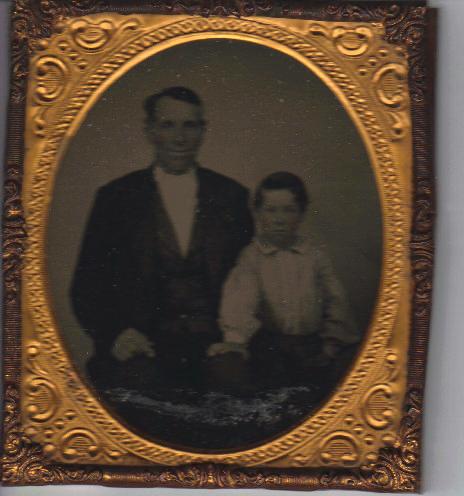
Jacob Poe and son Charles E ca 1860 (Frances and John Finley Collection)
On 27 Dec 1838, Jacob Poe married Mary Ann Ebert the daughter of Frederick Ebert and Mary Ann Hague. The marriage of Mary Ann and Jacob lasted 52 years and produced six sons. Only two of the sons followed in their father’s footsteps: George WE as a pilot and Theodore Cochran (Dory) as a clerk and wharf boat manager. Charles Edgar was the proprietor of the Riverside livery,feed, and sale stable. Two sons, Adam H and Albert G, died within one year, and little is known about Carson. Mary Ann Ebert was the sister of Capt George Washington Ebert who was a business partner in many Poe family packets. GW Ebert married Nancy Ann Poe, the sister of Jacob Poe. Brother and sister married brother and sister. Families connections do not get much tighter than that.
Early River Business Ventures. Relatively little of the early Capt Jacob Poe river story remains. According to Capt Adam Poe’s Account of Adam Poe, Sr River Experiences written in Georgetown, Penna May 3,1887 and published in 1891, Capt Adam started working with his father at age nine in 1825. [2] It is most probable that Capt Jacob worked for his father when the family returned to Georgetown, PA in 1823, as Jacob would have been age ten. For the next fourteen years, Jacob worked on rafts, flatboats, and keel boats with his father and brothers. Like his brother Capt Adam, Jacob probably worked as a roustabout on early designed steamboats. Through this experience, he was schooled in river navigation and steamboat design and operation. Like all pilots, he learned the name of every town, tavern, island, sand bar, bend, snag, wreck, and ripple on the river. Adam wrote about going “up through Merriman’s Ripple where the channel runs close to shore”. This navigational knowledge was stored in the pilot’s mind. A pilot was a flesh and blood GPS. Although the first evidence of Jacob’s work on a steamboat was in 1837, it should be recognized that Jacob, and many other Georgetown men, continued to build and operate keel boats into the 1850′s. These mid-century keel boats were quite large, more than 20 tons because they were registered in the Certificates of Enrollment for the Port of Pittsburgh. These vessels operated in low water and usually hitched a ride on a steamboat when returning up river. (The Certificates of Enrollment information is maintained in Washington, DC by the National Archives and Records Administration (Record Group 41) Records of the Bureau of Marine inspection and Navigation Customhouse copies of Vessel Documentation Pittsburgh, PA.)
According to Capt Adam Poe, the owners of the Beaver No 2 hired his brother Jacob Poe as their captain and first pilot in 1837. The Beaver No 2 was in the Allegheny River trade transporting passengers and feight between Pittsburgh and various canal stops. At that time Jacob Poe was one of two steamboat pilots on the Allegheny River. [3] That same year Jacob Poe was the pilot on the New Castle that went up the Allegheny River to Olean, NY. [4] This trip was an incredible feat for the time. No boat had steamed farther up the Allegheny River. According to Gladys L Hoover, president of the Mill Creek Historical Society, only two steamboats ever made the run to Olean – the str Allegheny and the str New Castle. At the age of 24 years, Jacob Poe’s reputation on the water was well recognized. This historic feat occurred 15 years before Jacob Poe had 15 or more years of fresh water experience before he posted his first certified steamboat pilot’s license. His last US Inspection Certificate was dated 1 Dec 1890. It was his fifteenth masters license and thirty-second pilots license for the Ohio and Cumberland Rivers. Fifty-three years as a Ohio River steamboat pilot ― think about that for a few moments.
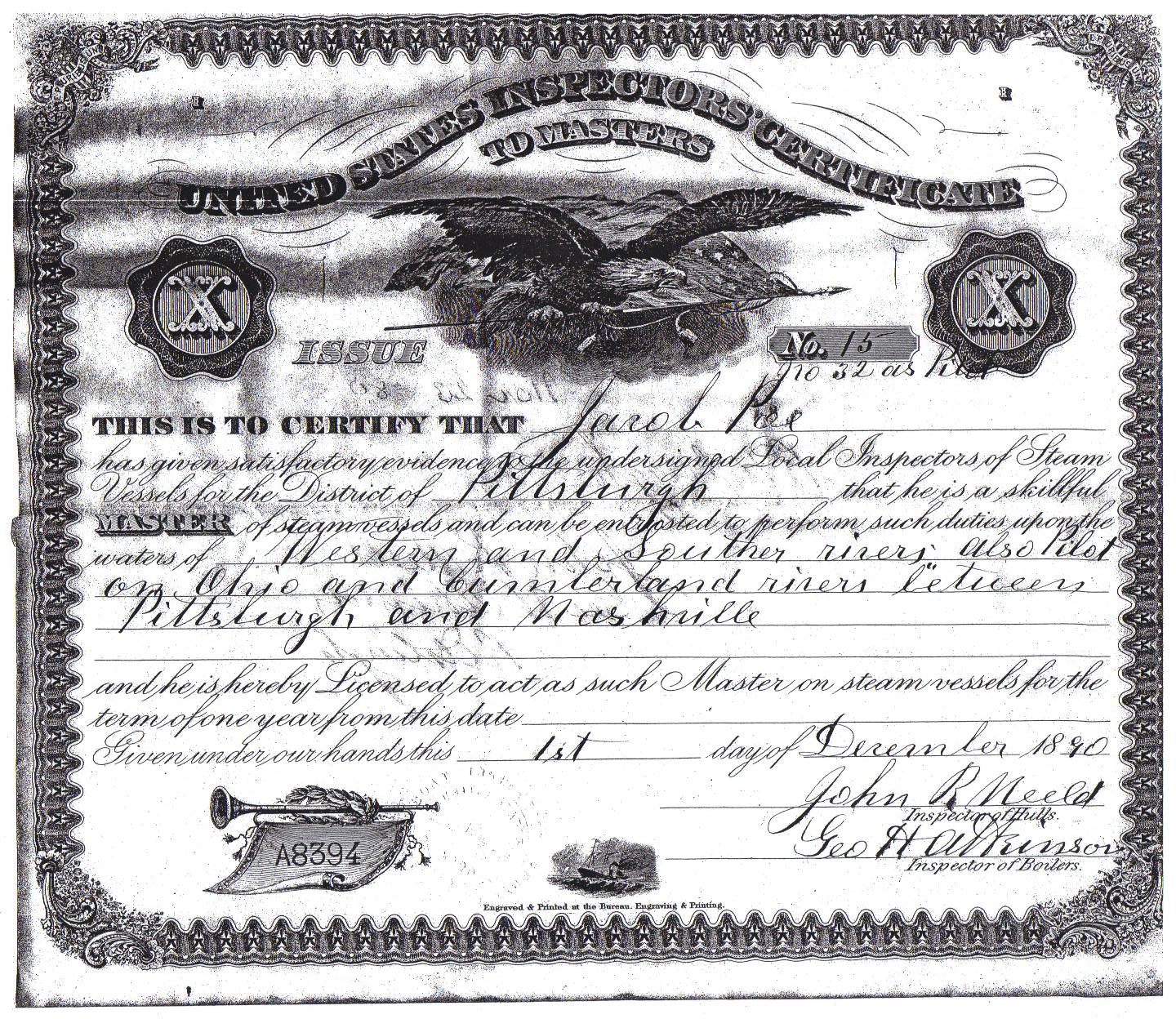
Poe Master License 1890 (Courtesy of the Wellsvile Ohio River Museum)
According to the Certificate of Enrollment records for the Port of Pittsburgh, Jacob Poe was the principle owner of the str Beaver in 1837. The hand-written book by Capt BM Laughlin identifying all packets built in Pittsburgh between 1811 and 1904, lists two packets named Beaver. The str Beaver rated at 31 tons was built in Pittsburgh and registered on 27 Nov 1832. Another str Beaver, also built in Pittsburgh was registered on 16 Apr 1837. The second vessel was undoubtedly the packet owned by Jacob Poe that Capt Adam Poe called the str Beaver No 2 in his account of his river experiences.
Str Beaver Certificate of Enrollment
| Owners and Partners | Share | Vol: | 6627 |
| Jacob Poe | Enroll No : | 30 | |
| Robert Beer | Cert Date: | 28 Mar 1837 | |
| TS Clarke | Cert Type:: | Enrollment | |
| Build Locn: | Pittsburgh, PA | ||
| Build Date: | 1837 | ||
| Master | Jacob Poe |
According to family lore, the Poe brothers, Adam and Jacob, bought the str Fallston in 1841 for low water work between Pittsburgh and Cincinnati. The str Fallston was a “go as you can” tramp steamboat that purportedly would run on dew. 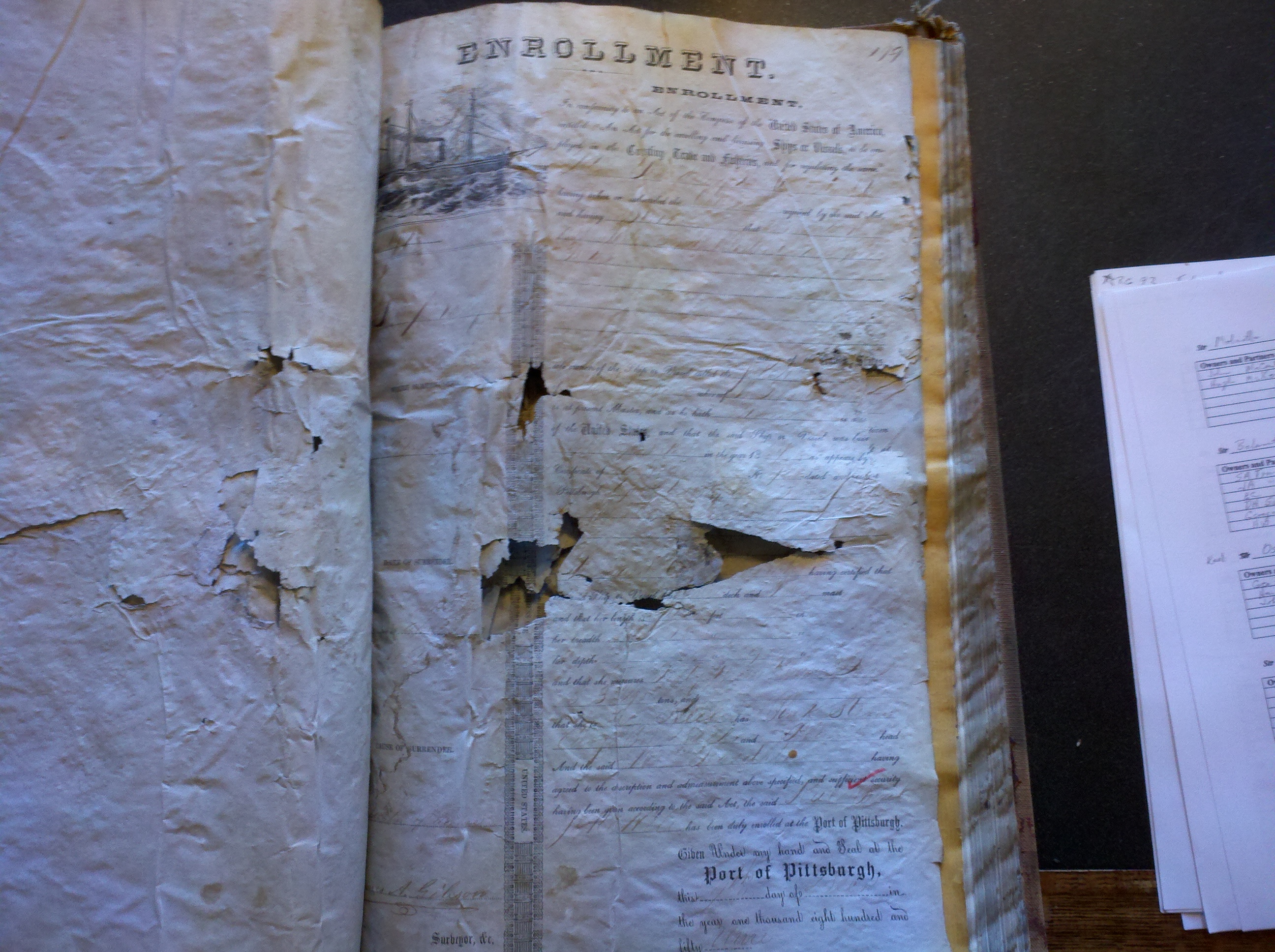 The first found Certificate of Enrollment was dated 10 Jun 1842. (It is not improbable that I missed an earlier record because the older Certificate of Enrollment books are in fragile condition.) The certificate confirmed that four Poe brothers were shareholders in the vessel in 1842. The shared ownership of the str Fallston was the first example of many Poe family packets. Risks and profits were shared within the family. The str Fallston was too small to accommodate passengers so two keelboats fitted with bunks were towed alongside. [5]
Str Fallston Certificate of Enrollment
| Owners and Partners | Share | Vol: | 6627 |
| Jacob Poe | Enroll No : | 57 | |
| Adam Poe | Cert Date: | 6/10/1842 | |
| Andrew Poe | Cert Type:: | Enrollment | |
| Thomas Poe | Build Locn: | Fallston, PA | |
| Build Date: | 1837 | ||
| Master | Jacob Poe |
In 1843 Jacob Poe purchased the Belmont which was built in Pittsburgh in 1842. The Belmont was larger than the Fallston and was used on the upper Ohio River system. From the owners list, it too was a Poe family packet.
Str Belmont Certificate of Enrollment
| Owners and Partners | Share | Vol: | 6627 |
| Jacob Poe | Enroll No : | 26 | |
| Adam Poe | Cert Date: | 10/26/1843 | |
| Thomas Poe | Cert Type:: | ||
| Andrew Poe | Build Locn: | ||
| Build Date: |
The documentary trail of the first few steamboats operated by Capt Jacob Poe is meager. In general, early steamboat facts are hard to come by. The definitive source of inland river packet information, “Ways Packet Directory, 1848-1994”, does not include boats built before 1848 as its title indicates. Unfortunately, much of Capt Jacob Poe’s career occurred before 1848.
The early steamboat days were also full of hardships and life shortening dangers. Floods, ice jams, fog, steamer wrecks, snags, sand bars, boiler explosions, and fire were dangers that confronted the officers of a packet. Mississippi diarrhea, cholera, jaundice, injury, consumption, and drowning were the constant companions of all of the crew and passengers. Steamboat passage was scarce, sometimes dangerous, in those days.
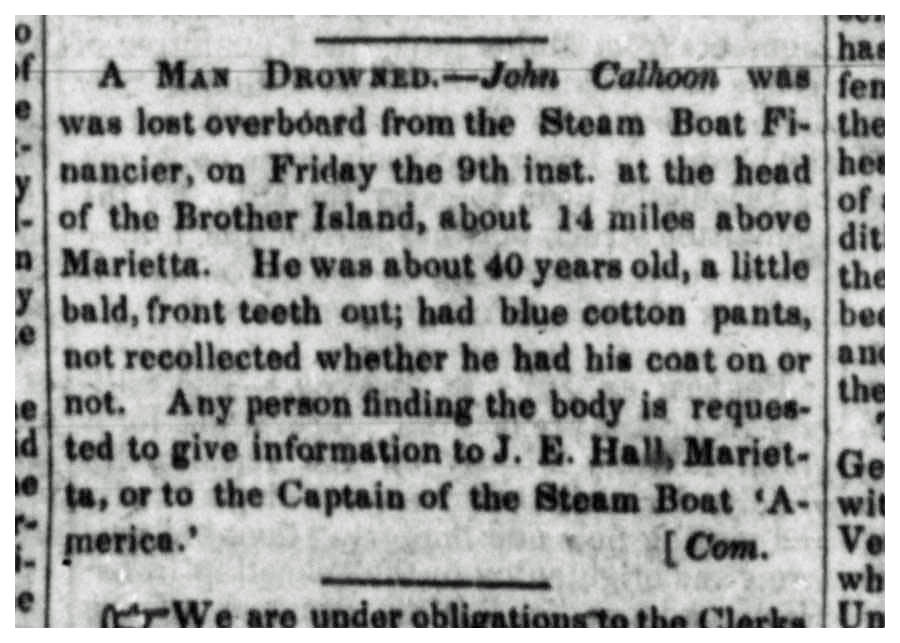
John Calhoon Drowning The Marietta Intelligencer 5 May 1846 p2c2
As proof of the dangers it should also be noted that Capt John Calhoon drowned in Marietta, OH in 1846 while in command of one of Jacob Poe’s steamboats. Capt John Calhoon was the father of Capt Thomas Stevenson Calhoon who arguably was the most renowned steamboat captain from Georgetown. Capt Joseph MC Calhoon died of “Cholera Morbus ” in Alton, IL in 21 Apr 1855. John and Joseph MC, brothers who were related to Jacob Poe by marriage and lived within foot distance, paid the river’s ultimate price.
River Commerce after 1848. By the mid-19th century, the technological wonder of the inland rivers had matured. Some packets were faster, but not so reliable; some were larger but also slower; some were more luxurious but carried less freight. Dangers had not been eliminated. The frontier rivers abounded in snags, sand bars, and other problems. Frontier, by definition, was the western territory unsettled and often lawless. With their boats Capt Jacob Poe and other steamboat men, often at great risk, supported the development and expansion of our frontiers. The following steamboat biographies highlight the work of Capt Jacob Poe.
John B Gordon. Capt Jacob Poe had a share in the sidewheel packet named John B Gordon built in Brownsville, PA in 1848. Its capacity was 57 tons. Capt Jacob Poe had the distinction of making a trip to Chillicothe, Oh via the Scioto River on Jan 31, 1848. The John B Gordon was snagged and sunk on the Arkansas River on 8 Jun 1851. I do not know whether Jacob Poe was aboard at the time of the wreck. [6]]
John B Gordon No 2. Then Jacob Poe built the John B Gordon No 2. Rated at 48 tons, it was a low water packet with a sternwheel design built in Brownsville, PA in 1849. It purportedly could run on heavy dew! [7] From an old journal of 1853, the steamboat arrivals and departures at Keosauqua, IA listed the strJohn B Gordon No 2 several times. An old diary similarly listed the arrivals at Fort Des Moines. The strJohn B Gordon No 2 had the distinction to ascend the Des Moines River to Fort Des Moines arriving on Sunday during church services. The congregation was dismissed to watch the unusual and historic event. [8] A similar celebration occurred when the first train reached Des Moines in Aug 1866. [9] In 1855 the John B Gordon No 2 was working on the Minnesota River, and later that same year was dismantled.[10]
The strJohn B Gordon No 2 was the first example of a typical Poe family packet. The Poe brothers favored the sternwheel design for their packets. These Poe family boats were not the nodding deep water boats of the lower Mississippi River. The Poe brothers believed that moderately sized packets yielded a better return on their investment. Costing less and shallow enough in draft because of their size, Poe boats could run on the upper Ohio and Missouri Rivers when the river level was too low for larger craft to operate. They could make more paying trips per season than owners of larger boats. This business philosophy made sense and proved its worth by returning good profits over the years.
Georgetown. The str Georgetown, a sternwheel packet built in Line Island and Pittsburgh in 1852, was a typical Poe family boat. The capacity was rated at 183 tons.
Str Georgetown Cert ofEnrollment
| Owners and Partners | Share | Vol: | 6635 |
| Thomas Poe | 3/16 | Enroll No : | 117 |
| Jacob Poe | 3/16 | Cert Date: | 24 Sep 1852 |
| George Poe | 1/16 | Cert Type:: | Enrollment |
| Joseph Calhoon | 3/16 | Build Locn: | Line Island, PA |
| Mrs AB McClure (Elizabeth Poe) | 2/16 | Build Date: | 1852 |
| Andrew Poe | 2/16 | Master | |
| GW Ebbert | 2/16 |
The Georgetown was snagged on the Missouri on 12 Oct 1853, raised, and returned to service. On 11 May 1855 the Georgetown was fatally snagged at Bellefontaine Bluffs on the Missouri in route to a military post. [11] Curiously, there is a record of the arrival in Des Moines, IA in 1855 of the str New Georgetown along with a number of other steamboats. [12] Neither Way’s directory nor The Lytle-Holdcamper List include a packet name New Georgetown so this entry must be the Poe boat which was working in the region.
Clara Poe. The Clara Poe was a trim sternwheel packet built in California, PA in 1859 (149x32x4’9”) and rated at 208 tons. Her first master was Capt Thomas W Poe. Ownership was shared as follows:
Str Clara Poe Certificate of Enrollment
| Owners and Partners | Share | Vol: | 6642 |
| Jacob Poe | 1/4 | Enroll No : | 182 |
| Thomas Poe | 1/8 | Cert Date: | 26 Nov 1859 |
| Martin L Poe | 1/8 | Cert Type:: | Admeasurement 11 |
| George Poe | 1/8 | Build Locn: | California, PA |
| Andrew Poe | 1/8 | Build Date: | 1859 |
| Jonathan Kinsey | 1/8 | Master | Thomas Poe |
| George W Ebbert | 1/8 |
The str Clara Poe was used in the Pittsburgh to Cincinnati trade until impressed into US service in 1862, according to Capt Frederick Way. [13] Capt Way erred on the date of service when he missed this troop departure vividly recorded on 18 Oct 1861.
The 78th PA Infantry boarded “on Captain Thomas Poe’s Clara Poe… At 6:00 PM ropes were released, whistles sounded, anchors weighed, and the Clara Poe… sailed quickly from the Monongahela River into the Ohio River enroute to their jump-off point of Louisville, Kentucky, some three days away.” The Clara Poe was one of six steamboats chartered by Commodore WJ Kountz, who had charge of the transportation by river of troops and Government supplies. [14] The other five steamers at the Monongahela Wharf that Oct day were the Moderator, Sir William Wallace, JW Hallman, Argonaut, and the Silver Ware. The Moderator in May 1863collided at night with the Horizon owned by Capt Thomas S Calhoon of Georgetown, PA. Many soldier lives were lost.
In Apr 1862, the str Clara Poe was a member of the expedition to Pittsburg Landing. Whether the str Clara Poe was chartered or impressed to service is unclear. [15] On May 13, 1863 the Clara Poe transported the 14th Illinois infantry from Memphis to Vicksburg. [16]
 The str Clara Poe was chartered from 24 Jun 1863 for an unknown period, from 4 Dec 1863 to 4 Jan 1864, and again from 8 Jul to 15 Aug 1864. [17] A report in the New York Times on Aug 15, 1864 stated “On Saturday noon of the last week the Clara Poe, bound for the Tennessee River with two heavy barges loaded with government stores, having on her own deck a load of fat cattle was attacked by a rebel force estimated at 700. The rebel commander Johnson ordered the Clara Poe to bring to, and upon her Captain refusing to comply. a fire of musketry was poured upon her.” The article goes on to state that the str Clara Poe had been pierced with approximately 500 musket bullets. It goes into great detail about the escape – discarding the barges, running the cattle off the deck into the river, etc. [18]
The str Clara Poe went up in flames – burned by rebels on 17 Apr 1865 at Eddyville on the Cumberland River while transporting supplies and barges of hay to Nashville. [19] The owners of the str Clara Poe formally requested indemnity from the US Army Quartermaster. Correspondence between the principal owners and the US government is available at the National Archives in the military “Vessel File” Record Group 92 Entry 1403 Box 81. The battle for compensation was waged by Capt Jacob Poe for twenty-five years through six presidencies, in vain.
Yorktown. The str Yorktown was a sternwheel packet built in Freedom, PA in 1864 with a rated capacity of 426 tons. Capt Jacob Poe, the initial owner, brought her out in Oct 1864 for a Pittsburgh to Louisville trip. From the files of the Pittsburgh “Commercial” dated 28 Oct 1864:
The new and pretty Yorktown, Capt Poe, leaves for Louisville Saturday.
In Jan 1865, Capt George W Ebert bought control of the packet with Standish Peppard serving in the office. Her main route was Pittsburgh to Cincinnati with an occasional trip to Nashville. [20]
Str Yorktown Certificate of Enrollment
| Owners and Partners | Share | Vol: | 6647 |
| Jacob Poe | 1/4 | Enroll No : | 212 |
| Thomas Poe | 1/4 | Cert Date: | 29 Oct 1864 |
| GW Ebbert | 1/8 | Cert Type:: | Admeasurement 23 |
| S Morrow | 1/8 | Build Locn: | Freedom, PA |
| A Hartuper | 1/8 | Build Date: | 1864 |
| WJ Parr | 1/8 | Master | Jacob Poe |

Str Yorktown Cabin Passage in 1868 (F Nash Collection)
In 1867 and again in 1868, the str Yorktown steamed to Ft Benton in the Montana Territory. In 1867, the str Yorktown docked at Ft Benton on 14 Jun with 210 tons of freight and 15 passengers. Like clockwork, the str Yorktown docked at Ft Benton on 14 Jun 1868 with 125 tons of cargo and 50 passengers. [21] It is unclear whether Jacob Poe was aboard as a pilot during these trips. The str Yorktown was off the books in 1869. [22]
Amelia Poe. The steamer Amelia Poe was named in honor of the daughter of Capt Thomas Washington and Martha Jane Poe born in Georgetown, PA in 1852. The trim sternwheel packet built in Georgetown, PA and finished in Pittsburgh in 1865 (165′x27′x4’5”) was designed specifically for Missouri River commerce. Her capacity was rated at 328 tons. Capt Thomas Washington was her first master and principle owner. [23]
Str Amelia Poe Certificate of Enrollment
| Owners and Partners | Share | Vol: | 6649 |
| Adam Poe | 1/8 | Enroll No : | 131 |
| Thomas Poe | 7/16 | Cert Date: | 11 May 1865 |
| Cornelius Todd | 1/16 | Cert Type:: | Admeasurement 126 |
| Jacob Poe | 1/8 | Build Locn: | Pittsburgh, PA |
| Jacob Ewing | 1/8 | Build Date: | 1865 |
| GW Hughes | 1/8 | Master | Adam Poe |
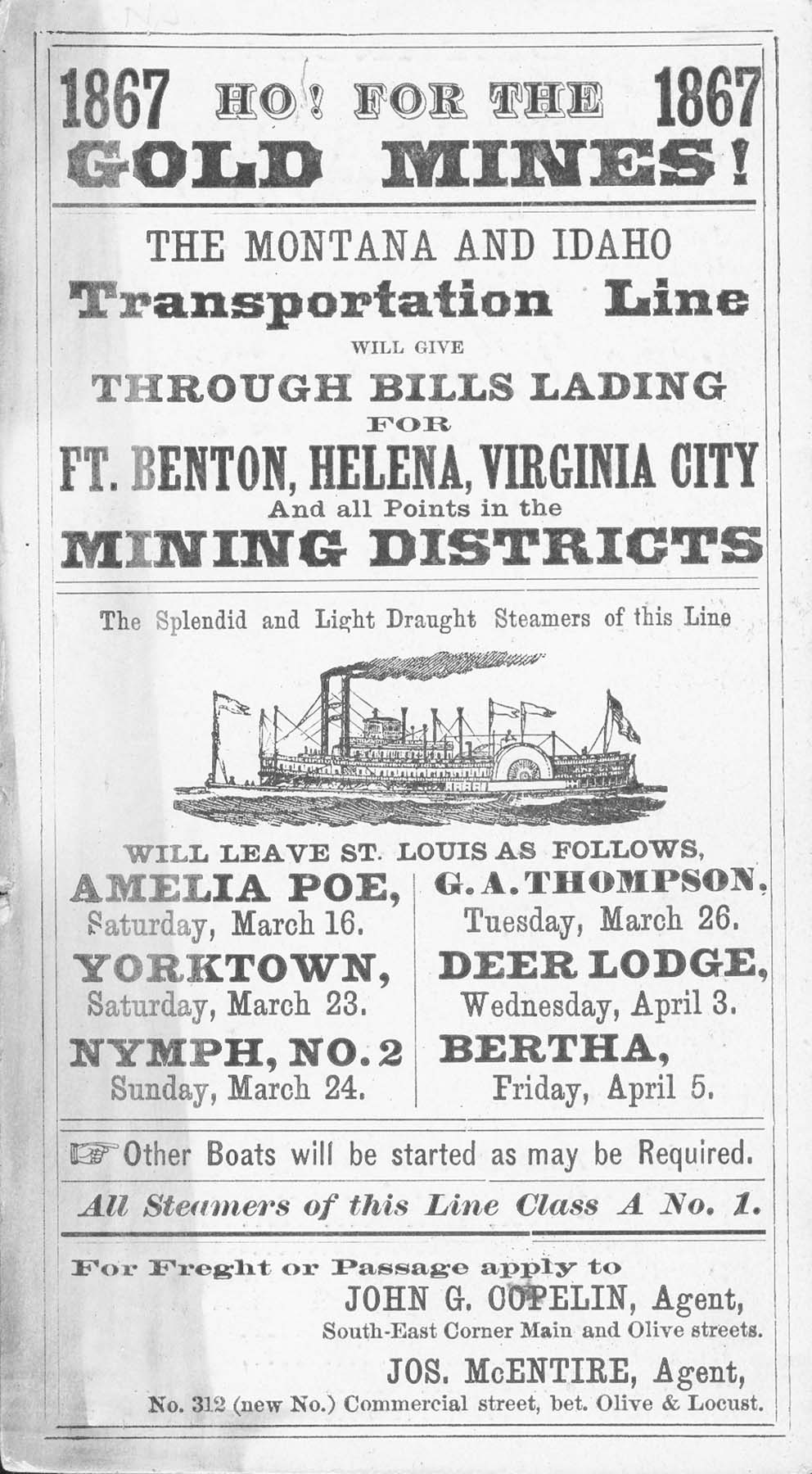
Montanna and Idaho Transportation Line Boarding Pass (The Ken Robison Collection)
In the spring of 1866, some 51 boats, including the str Amelia Poe, started from St Louis for the upper Missouri. Only 32 docked at Ft Benton. On Jun 11, 1866, the str Amelia Poe arrived at Ft Benton with 200 tons of freight and 40 passengers. [24] Downward freight and passengers were unrecorded. The str Amelia Poe departed from Georgetown landing on 13 Mar 1866, departed from Cincinnati on 20 Mar arriving in St Louis on 25 Mar. The date of departure from St Louis was 30 Mar arriving in Ft Benton at 3:30 PM on 11 Jun. Seventy-three (73) grueling, watery days!
In 1868, the str Amelia Poe again steamed to Ft Benton. On May 20, 1868 the str Amelia Poe passed Ft Buford without stopping. Loaded down with a quartz mill for the Montana mines and a cargo of whiskey and other liquors, she snagged near Oswego, MT on May 24 attracting 1,500 swarming Indians in a riotous salvage operation. The location where the packet snagged and sunk is now known as Amelia Poe Bend. Part of the cargo was saved by the str Cora and taken to Helena MT. Some machinery, the quartz mill equipment, was put ashore where it remains to this day. The loss was reported to be $72,000. [25] The Poe passengers were carried to Ft Benton by the steamer Bertha. The quartz mill was stowed ashore, and as late as 1927 was still visible.[26]

Str Amelia Poe wreckage on Upper Missouri River (The Montana Standard 09 Nov 2002)
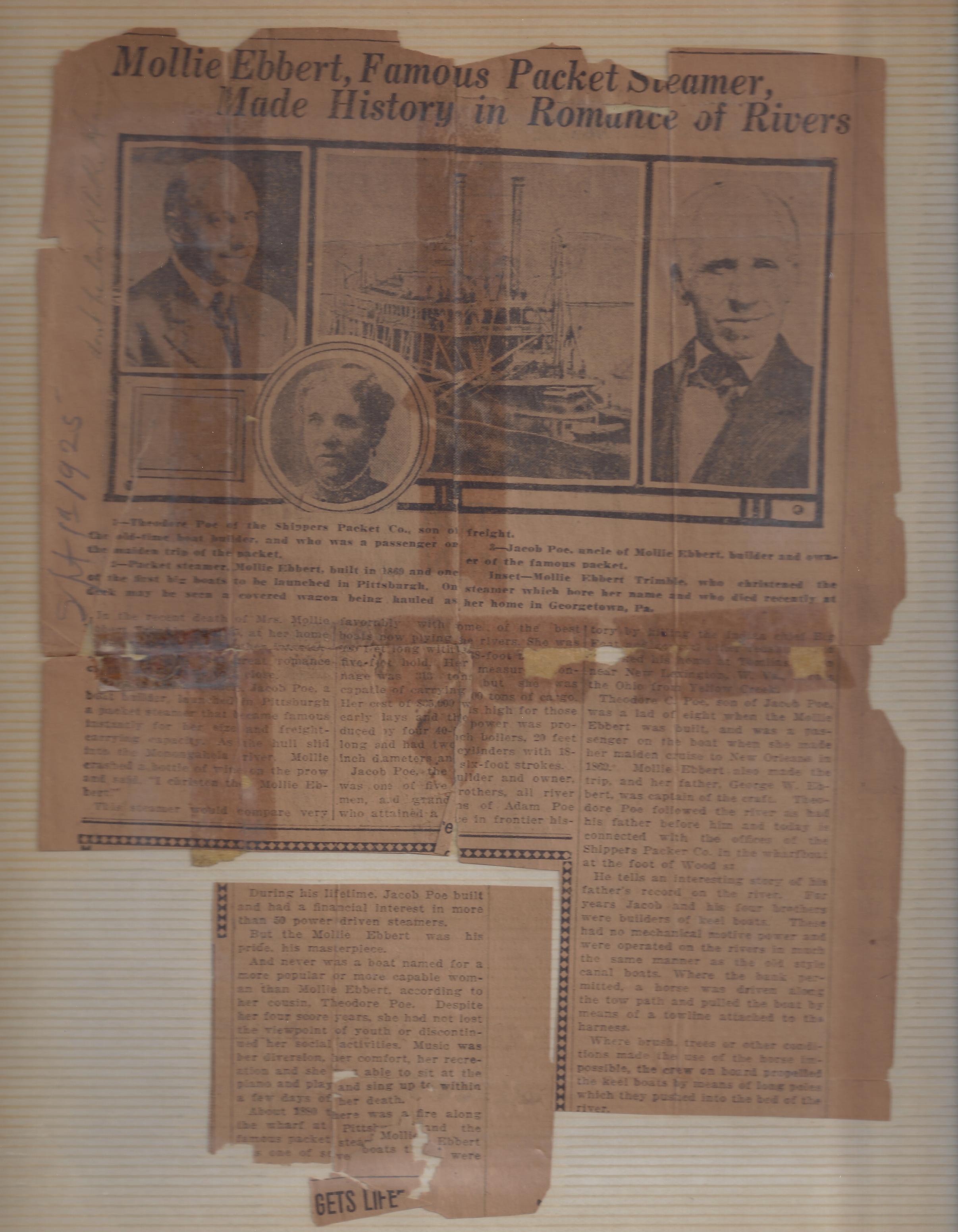
Mollie Ebert. The str Mollie Ebert was a sternwheel wooden hull packet built in Pittsburgh in 1869. Built under the watchful eye of Capt Jacob Poe, the packet became famous instantly for her size and freight capacity. Although Way’s Directory indicates that the packet was a modest sized boat, in an interview of Theodore C Poe in the Sunday Pittsburgh Press dated 8 Nov 1925 the size was described differently. The packet was 180x38x5 with a calculated capacity of 313 tons. But according to Theodore C Poe the str Mollie Ebert was capable of transporting 600 tons of cargo. Launched by Jacob Poe, the steamer Mollie Ebert was named for his niece Mary Ann (Mollie Ebert) Trimble. This steamer was his masterpiece. It cost $35,000. It was luxurious – bound to be noticed. Its boilers and cylinders were exceptionally powerful. By design, it was perfect for the profitable “mountain trade” on the upper Missouri River. [27]
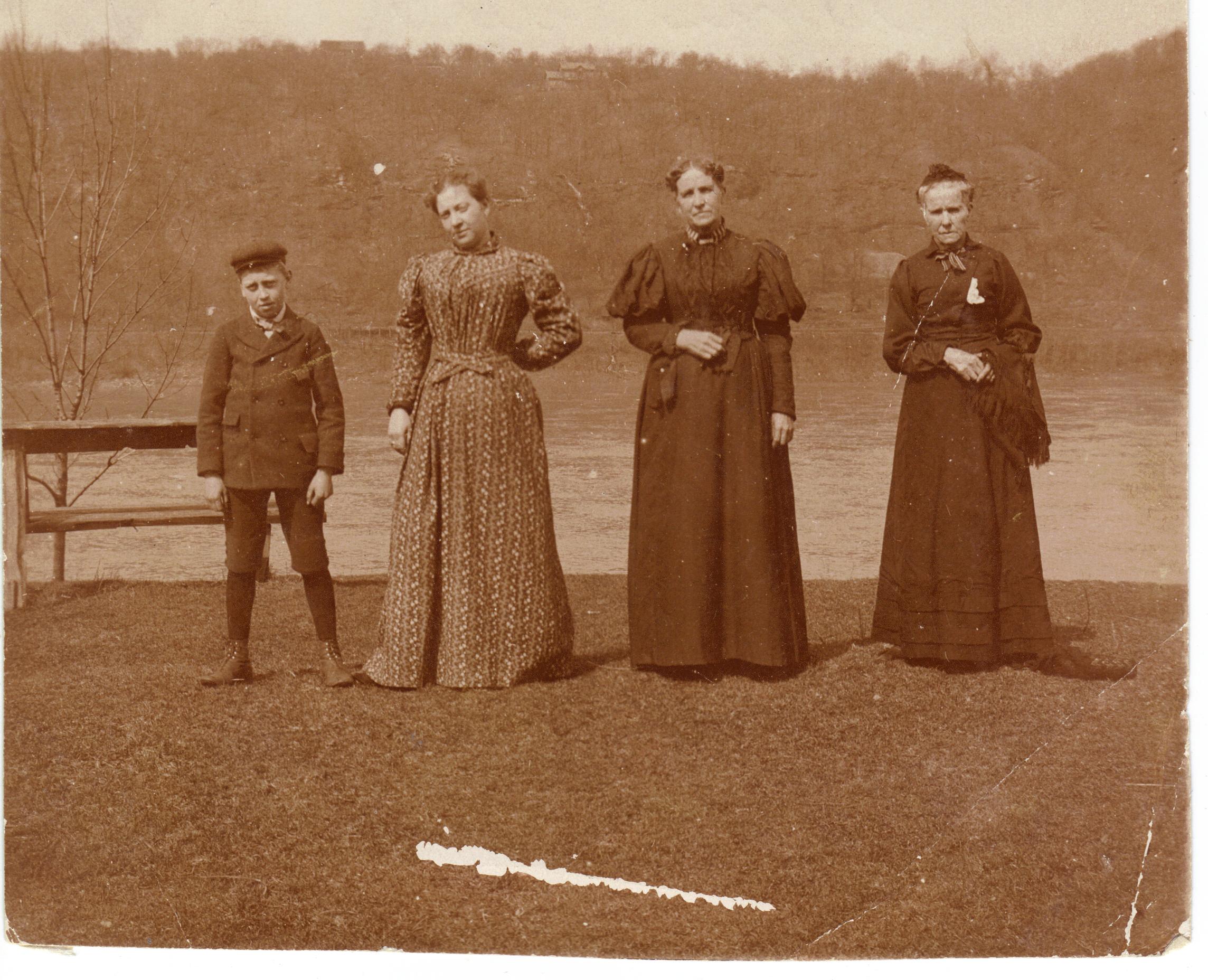
Three Generations of Poe Women:DelenaTrimble Nash, Mollie Ebert Trimble, Nancy Poe Ebert. (The Anna L and John F Nash Collection)
Mollie Ebert Trimble and her Aunt Elizabeth Poe Mathews helped christen the steamer with a high-profile launch. As the hull slid into the Monongahela River, Mollie Ebert Trimble smashed a bottle of wine on the prow and said, “I christen thee Mollie Ebert.” Then with Capt George W Ebert in command, they went on her maiden voyage to New Orleans. Theodore C Poe, son of Jacob Poe, only eight years when the Mollie Ebert was built, was a passenger on her maiden voyage to New Orleans. [28]
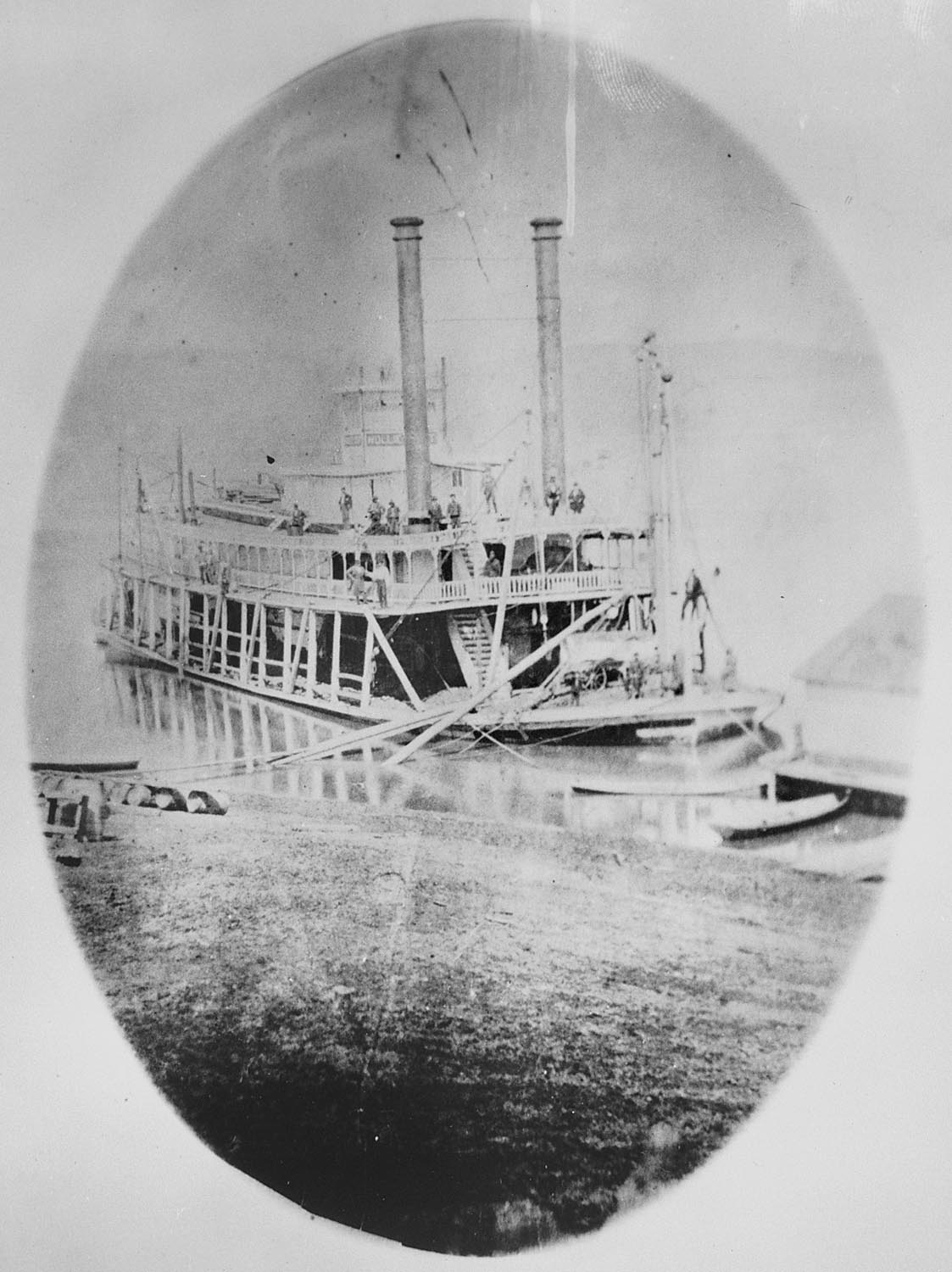
Str Mollie Ebert (Photo courtesy of Murphy Library, University of Wisconsin – La Crosse)

Str Mollie Ebert Boarding Pass 1874 (F Nash Collection)
Barranquilla. The str Barranquilla was a trim sternwheel wooden hull packet built in Pittsburgh, PA in 1869 under the supervision of Capt Jackman Taylor Stockdale of Georgetown, PA. She was contracted for work on the Magdalena River in Columbia, South America. Her first master was Capt Thomas S Calhoon; Jacob Poe and Andrew J Parr served as pilots. No doubt other Georgetown men including Poes helped deliver the steamer to Columbia. [29]
The route from Pittsburgh to the Magdalena River was long and dangerous. Capt Jacob Poe and Capt Andrew J Parr piloted to New Orleans or Baton Rouge. From there a “Bar Pilot” was hired to steer the steamboat from New Orleans or Baton Rouge through the ever-changing channel to the mouth of the Mississippi. (Today every seafaring tanker and ship, inbound and outbound, is required to use three different certified and well paid bar pilots to navigate the river from its mouth to Pilottown to the upstream anchorage and finally to the wharves.)
Sternwheel packets with their low draught were not designed for ocean adventures. One playful slap from the ocean and a river steamboat would provide kindling on the beach for years. From the mouth of the Mississippi, the packet sailed along the coast to Key West. From there she island hopped via Jamaica to reach her destination; badly battered but operative.
Glencoe. The str Glencoe was a sidewheel wooden hull packet built in Shousetown, PA in 1870 and completed in Pittsburgh in 1871. It was a big sidewheeler (275x43x7) built for deep water and operation in the Louisville to New Orleans trade. The original owners were Capt Thomas S Calhoon and Capt Jackman T Stockdale. The pilots who took her out for her maiden voyage were Jacob Poe and his son George WE Poe. The first clerk was John QA Parr. All lived within foot distance of Georgetown landing. [30]
General Chas H Tompkins. In 1878, the str General Chas H Tompkins, a sternwheel packet was built in Pittsburgh for William J Kountz. Piloted by Jacob Poe, she left Pittsburgh on May 12, 1878 for the Missouri River. She was lost on the Arkansas River after 1881. This packet was the last known command in Capt Jacob Poe’s career.

Jacob Poe Pilots License dated 1862 (F Nash Collection)
Personal Wealth. According to 1860 census data, Jacob Poe had a net worth greater than $1M converted to 2013 dollars. His declaration was second to his brother Thomas Washington Poe in the borough of Georgetown, PA. In 1870, the order was the same, but the amounts were reduced by 30%. The war years had not been good for river commerce. At the outbreak of the war, the secessionists blocked all Mississippi River commerce. During the war whether contracted of forced to service by the US Army Quartermaster, packet business was unprofitable. Wage scales controlled by the Quartermaster were less than pre-war rates. After the Civil War, even the high profit of the Missouri River commerce during the Montana gold rush was not enough for many packet owners to recover from the swerves of fortune caused by the war. Still by any measure, the Georgetown captains and pilots in 1870, especially Jacob Poe, were wealthy men for their time.
Jacob Poe Deed Lot 21 (Frances and John Finley Collection)
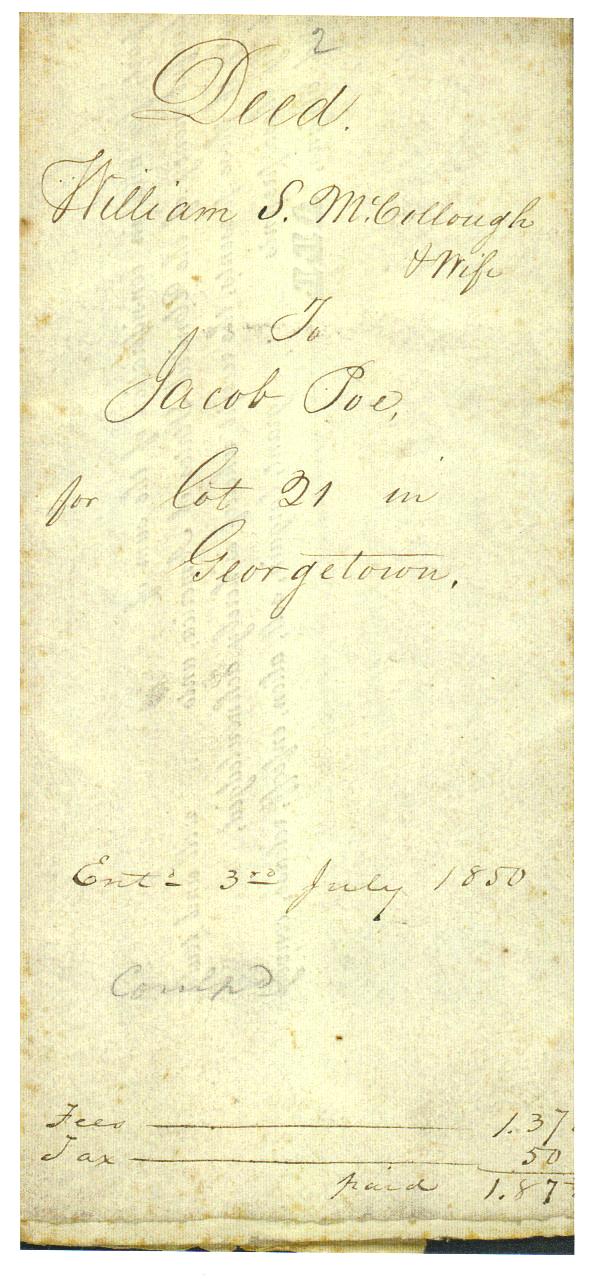
Capt Jacob Poe also owned a number of properties in Georgetown. By 1850 he owned the three lots which combined today are known as The Poe House. The lot where his sister Nancy Ann and her husband Capt George Washington Ebert built their home in the late 1840′s was sold to them by him. To his sons he gave property near the end of his life. He also bought the property known as Poe Wood, near Georgetown, from the heirs of his granduncle, Revolutionary War Capt Andrew Poe’s. His grandfather Adam’s patent had been named Poesville. Poesville was lost to the family when Adam moved his family to Ohio in 1804.
Summary.
Ringed in romance and smoke, the American inland river steamboat is one of our most colorful and precious heritages. The light draft vessel was the technological wonder of its day providing access to the western territories decades before the arrival of the railroads. That many Americans continue to be fascinated by the historical exploits and romantic spirit of steamboats is completely understandable. However, no captain or pilot from Georgetown, PA earned much renown either during his lifetime or the years after his death. During the Civil War, they like many other steamboat men sacrificed, suffered, and learned to live with their losses. They served from start to finish, fought summer and winter, but their history has been essentially silent.
Few river men traveled farther or as wider-ranging as Capt Jacob Poe. In 1837, Capt Jacob steamed to Olean, NY on the Allegheny River; in 1848 Chillicothe, OH on the Scioto River; in 1849 Ft Des Moines on the Des Moines River; in 1851 Warsaw MO on the Osage River; in 1854 Ft Riley on the Kansas River. During the Civil War, Capt Jacob Poe was transporting troops and supplies on the Red River, White River, Yazoo River, and of course the Tennessee and Cumberland Rivers. After the Civil War he was on the furious upper Missouri River making several trips to Ft Benton in the Montana Territory. He spent his life steaming on the sharp edge of a constantly moving American frontier, making history.
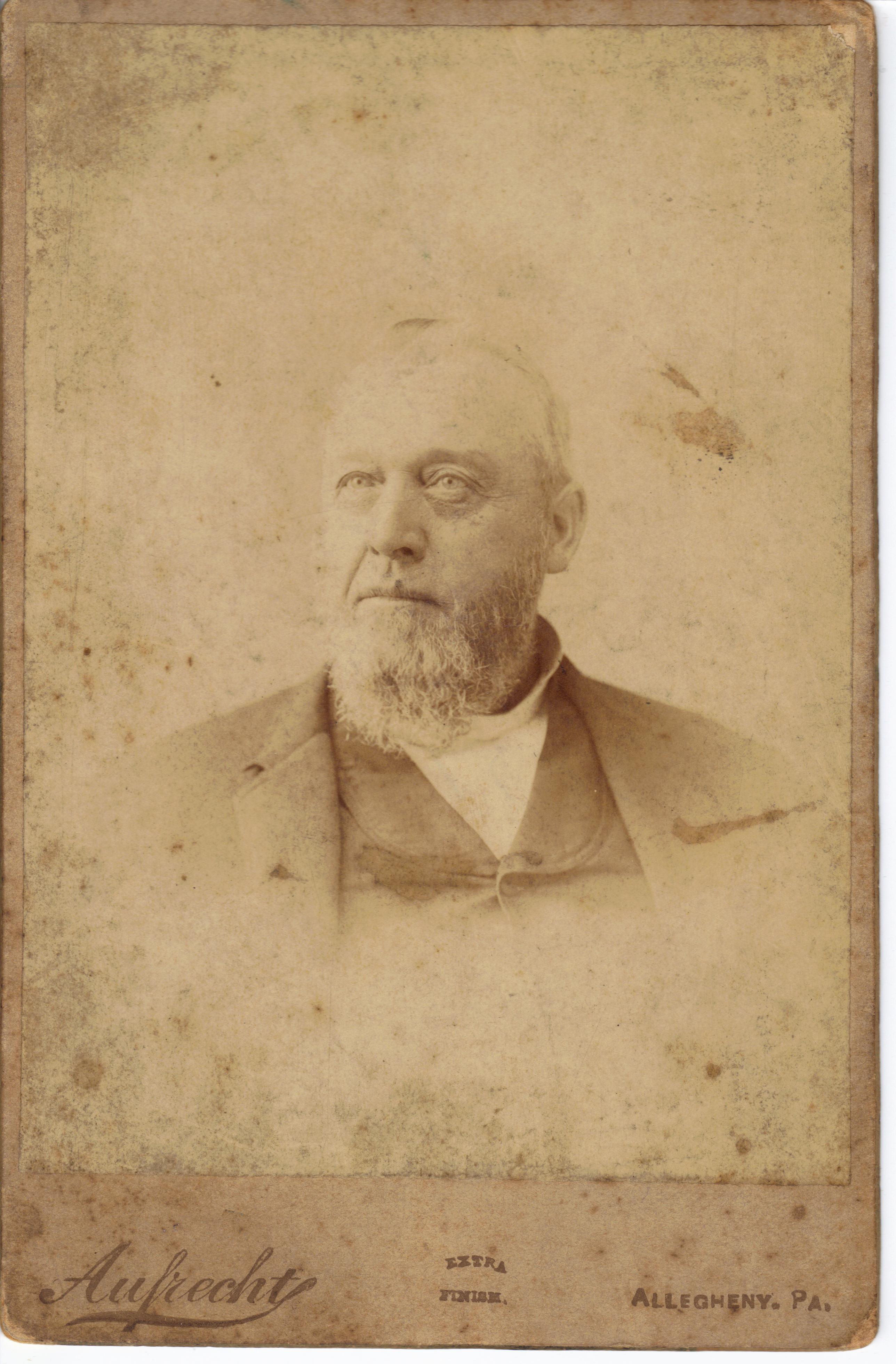
Capt Jacob Poe (Anna L and John F Nash Collection)
From the details available, Capt Jacob Poe was often mentioned as the pilot. He seemed to favor work in the pilot house more than the packet management position of the master or captain. He preferred to read the waters rather than count the money. He not only drove the boats and shared their ownership with his brothers, he often watched over the construction of family boats. No doubt his ideas were the foundation of the Poe favored mid-sized sternwheel design.
For those who only remember the Poe family of pioneer days because of their celebrated fight with Big Foot, the Wyandot Indian chief, they are missing the astonishing record of their work as steamboat captains and pilots. That astonishing record was achieved in a single generation. The Poe brothers, especially Jacob, were all touched by history.
Capt Jacob Poe achieved an undying reputation as a steamboat man. Today it seems being a steamboat pilot was a far-fetched job, like an astronaut or lion tamer; things worthy of song or verse, but something that real people do not do. But Jacob Poe was the real deal. His life was important and fascinating.
Georgetown Cemetery Markers and Death Notifications .
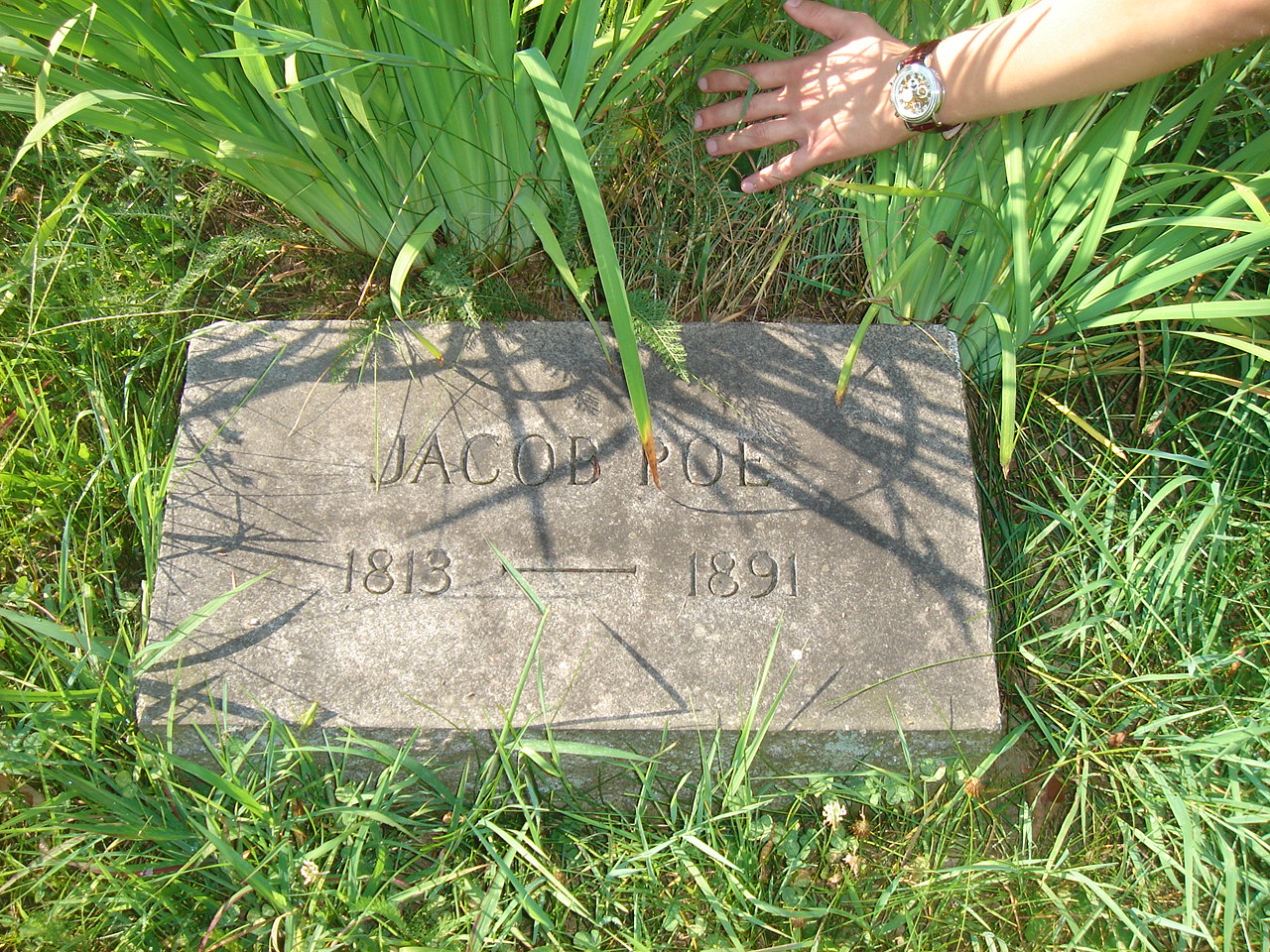
Jacob Poe Marker (F Nash Photo)

Mary Ann Poe 1820 1905 (F Nash Collection)
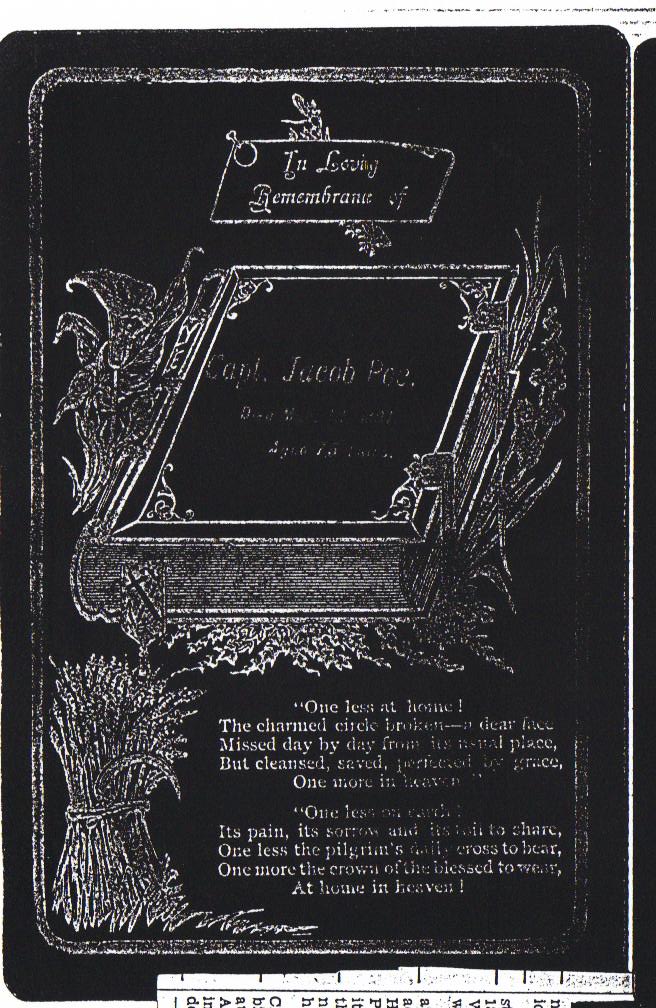
Jacob Poe Death Card copy (Anna L and John F Nash Collection)
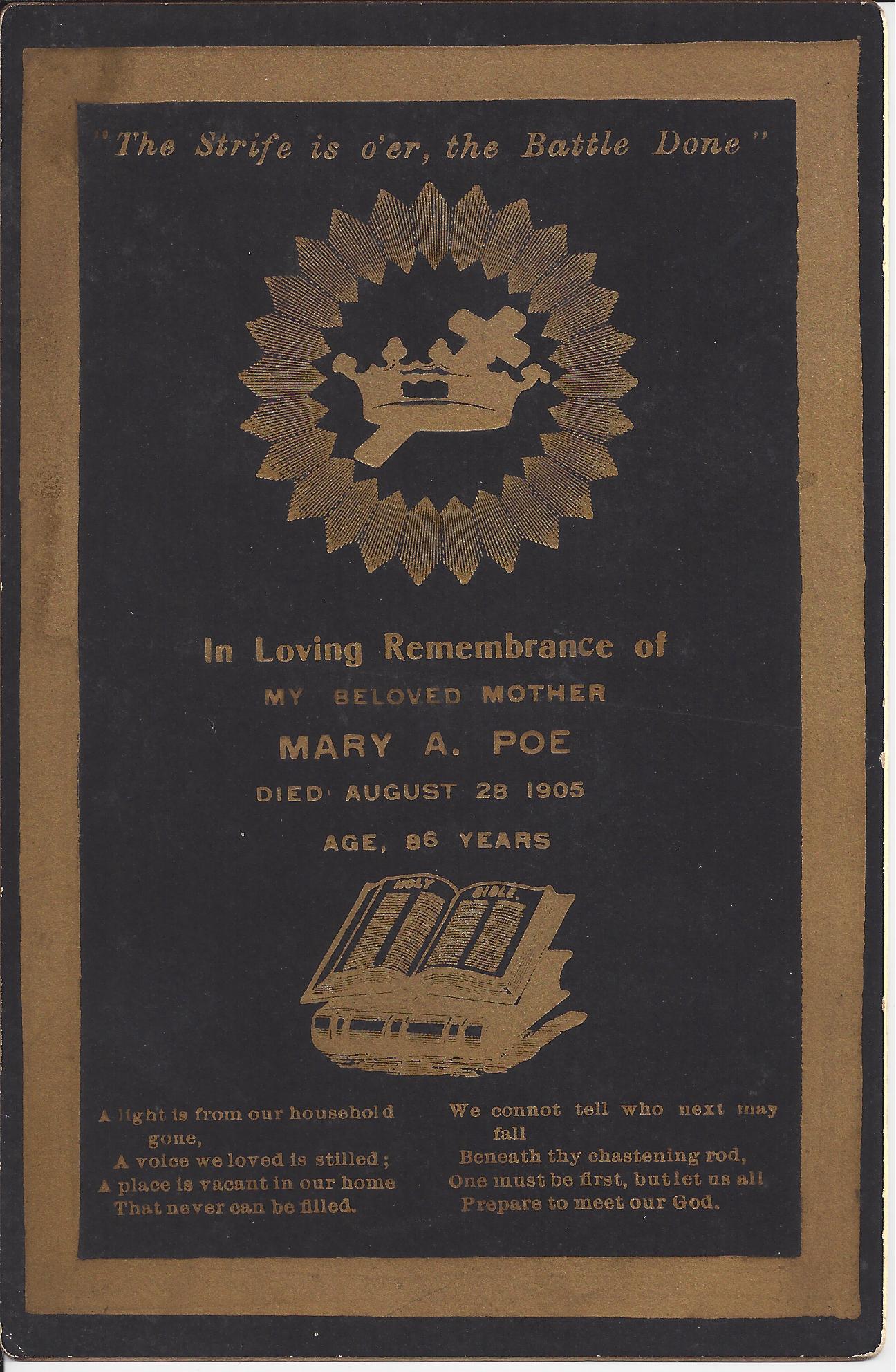
Mary Ann Ebert Poe Death Notice (Anna L and John F Nash Collection)
Summary of Packets and Keel Boats Ownership
(The summary information for Jacob Poe in the following table was gleaned from a personal review of the Certificates of Enrollment for the Port of Pittsburgh stored in The National Archives. According to Theodore C Poe in the newspaper article dated 1 Sep 1925, his father had an interest in more than fifty boats. From my research, I have information on thirty-two packets and two keelboats. The day is not done.)
| Packet Name | Date | Location | Owner | Master |
| Amelia Poe | 1865 | Pittsburgh | Thomas Poe | Adam Poe |
| Argyle | 1853 | Freedom | James Hutchinson | GW Ebert |
| Barranquilla | 1869 | Pittsburgh | Jackman Stockdale | Thomas S Calhoon |
| Beaver | 1837 | Pittsburgh | Jacob Poe | Jacob Poe |
| Belfast | 1843 | Freedom | Jacob Poe | GW Ebert |
| Belfast No 2 | 1857 | Freedom | Jacob Poe | GW Ebert |
| Belmont | 1842 | Pittsburgh | Jacob Poe | Jacob Poe |
| Belmont No 2 | 1856 | California | Thomas W Poe | GW Ebert |
| Caledonia | 1854 | Pittsburgh | Richard Calhoon | |
| Clara Poe | 1859 | California | Jacob Poe | Thomas W Poe |
| Clifton | 1855 | Glasgow | Jacob Poe | |
| Columbiana | 1843 | Elizabeth | Jacob Poe | Samuel Smith |
| Fairmont | 1837 | Fallston | Jacob Poe | Jacob Poe |
| Fallston | 1837 | Fallston | Jacob Poe | Jacob Poe |
| Financier | 1845 | Pittsburgh | Jacob Poe | Adam Poe |
| Financier No 2 | 1850 | Freedom | Jacob Poe | Adam Poe |
| Gen Chas H Tompkins | 1878 | Pittsburgh | William J Kountz | |
| Georgetown | 1852 | Line Island | Jacob Poe | |
| Glencoe | 1870 | Shousetown | Jackman Stockdale | Thomas S Calhoon |
| Grand Turk | 1854 | McKeesport | Jacob Poe | |
| Hudson | 1846 | Glasgow | Jacob Poe | GW Ebert |
| John B Gordon | 1848 | Brownsville | Jacob Poe | Jacob Poe |
| John B Gordon No 2 | 1849 | Brownsville | Jacob Poe | Jacob Poe |
| Mollie Ebert | 1869 | Pittsburgh | GW Ebert | GW Ebert |
| Neptune | 1856 | California | Adam Poe | Adam Poe |
| New Castle | 1834 | Pittsburgh | Joshua Leech | Joshua Leech |
| New England | 1844 | Pittsburgh | Jacob Poe | GW Ebert |
| Pioneer | 1846 | Elizabeth | Jacob Poe | Adam Poe |
| Tuscarora | 1848 | Glasgow | Jacob Poe | Jacob Poe |
| Washington City | 1852 | Freedom | Jacob Poe | GW Ebert |
| Yorktown | 1853 | Pittsburgh | Jacob Poe | |
| Yorktown No 2 | 1864 | Freedom | Jacob Poe | Jacob Poe |
| Keel Boat Name | Date | Location | Owner | |
| Big Foot | 1850 | Glasgow | Jacob Poe | |
| Monsoon | 1849 | Georgetown | Jacob Poe | |
References.
[1] Capt Frederick Way, Jr., The Steamboating Poe Family, (S&D Reflector) (Dec 1965)).
[2] Adam Poe, A True History of Adam Poe Indian Spy, Who Killed Big Foot, University of Pittsburgh Libraries, 1891, p 8.
[3] Adam Poe, A True History of Adam Poe Indian Spy, Who Killed Big Foot, University of Pittsburgh Libraries, 1891, p 10.
[4] Capt Frederick Way, Jr., The Steamboating Poe Family, (S&D Reflector) (Dec 1965)).
[5] Ibid.
[6] Frederick Way, Jr.,Way’s Packet Directory, 1848-1994, (Ohio University Press, Athens 1994), p. 249.
[7] Capt Frederick Way, Jr., The Steamboating Poe Family, (S&D Reflector) (Dec 1965)).
[8] Tacitus Hussey, History of Steamboating on the Des Moines River, from 1837 to 1862, (Annals of Iowa Vol IV, No 5),(April 1900), p357-359.
[9] Ibid, p 363.
[10] Frederick Way, Jr.,Way’s Packet Directory, 1848-1994, (Ohio University Press, Athens 1994), p. 249.
[11] Frederick Way, Jr.,Way’s Packet Directory, 1848-1994, (Ohio University Press, Athens 1994), p. 186.
[12] Tacitus Hussey, History of Steamboating on the Des Moines River, from 1837 to 1862, (Annals of Iowa Vol IV, No 5),(April 1900), p361.
[13] Frederick Way, Jr.,Way’s Packet Directory, 1848-1994, (Ohio University Press, Athens 1994), p. 99.
[14] Arthur B Fox, Pittsburgh during the Civil War, 1860-1865, p. 31-32.
[15] Charles Dana Gibson and E Kay Gibson, Dictionary of Transports and Combatant Vessels Steam and Sail Employed by the Union Army 1861 – 1868, (Ensign Press, Cambridge, MA 1995), p 63.
[16] Internet Complete History of the 46th Illinois Veteran.
[17] Charles Dana Gibson and E Kay Gibson, Dictionary of Transports and Combatant Vessels Steam and Sail Employed by the Union Army 1861 – 1868, (Ensign Press, Cambridge, MA 1995), p 189.
[18] New York Times Aug 15, 1864.
[19] Frederick Way, Jr.,Way’s Packet Directory, 1848-1994, (Ohio University Press, Athens 1994), p. 99.
[20] Frederick Way, Jr.,Way’s Packet Directory, 1848-1994, (Ohio University Press, Athens 1994), p. 493-494.
[21] Joel Overholser, Fort Benton World’s Innermost Port, (River & Plains Society, 1987), p. 64-69.
[22] Frederick Way, Jr.,Way’s Packet Directory, 1848-1994, (Ohio University Press, Athens 1994), p. 493-494.
[23] Frederick Way, Jr.,Way’s Packet Directory, 1848-1994, (Ohio University Press, Athens 1994), p. 99.
[24] Joel Overholser, Fort Benton World’s Innermost Port, (River & Plains Society, 1987), p. 54-59.
[25] Dr EB Trail, Steamboat Arrivlas at Fort Benton, Montana, Montana Historical Society Collection, Vol I, State Historical Society of Missouri.
[26] Joel Overholser, Fort Benton World’s Innermost Port, (River & Plains Society, 1987), p. 68-69.
[27] Steamboating and the Georgetown People, (Sunday Pittsburgh Press, 8 Nov 1925).
[28] Ibid.
[29] Frederick Way, Jr.,Way’s Packet Directory, 1848-1994, (Ohio University Press, Athens 1994), p. 38.
[30] Capt Frederick Way, Jr., The Steamboating Poe Family, (S&D Reflector (Dec 1965)).
Copyright © 2013 Francis W Nash
All Rights Reserved
No part of this website may be reproduced without permission in writing from the author.